- Have any questions?
- (323) 988-1269
- [email protected]





When an important document needs to be notarized, knowing what to expect can make the signing process much easier. Notarization is commonly used for documents where identity verification, proper signing procedures, and an impartial witness are important. For residents, professionals, families, and businesses in the area, convenient mobile notary services in Rancho Dominguez can provide a practical way to complete eligible notarization needs.
A notary public does not generally decide whether a document is legally correct or whether its contents are accurate. Instead, the notary follows California notarial procedures to verify the signer’s identity, confirm the signer is acting willingly and understands the signing, complete the required notarial certificate, and maintain the appropriate journal records when required.
From affidavits and powers of attorney to real estate documents and business paperwork, many different types of documents may require notarization depending on the circumstances. Understanding which documents commonly need a notary can help you prepare before your appointment.
A notary public serves as an impartial official who performs specific duties during the signing of qualifying documents. One of the most important responsibilities is verifying the identity of the person signing.
The signer generally needs to personally appear before the notary and provide acceptable identification when required. The notary may also confirm that the signer understands what they are signing and is not being forced or pressured into the transaction.
It is important to understand that notarization does not automatically make a document legally valid. A notary cannot provide legal advice, draft legal documents, or determine whether the document protects the signer’s interests.
For legal questions about a document, the signer should consult an appropriately licensed attorney or another qualified professional.
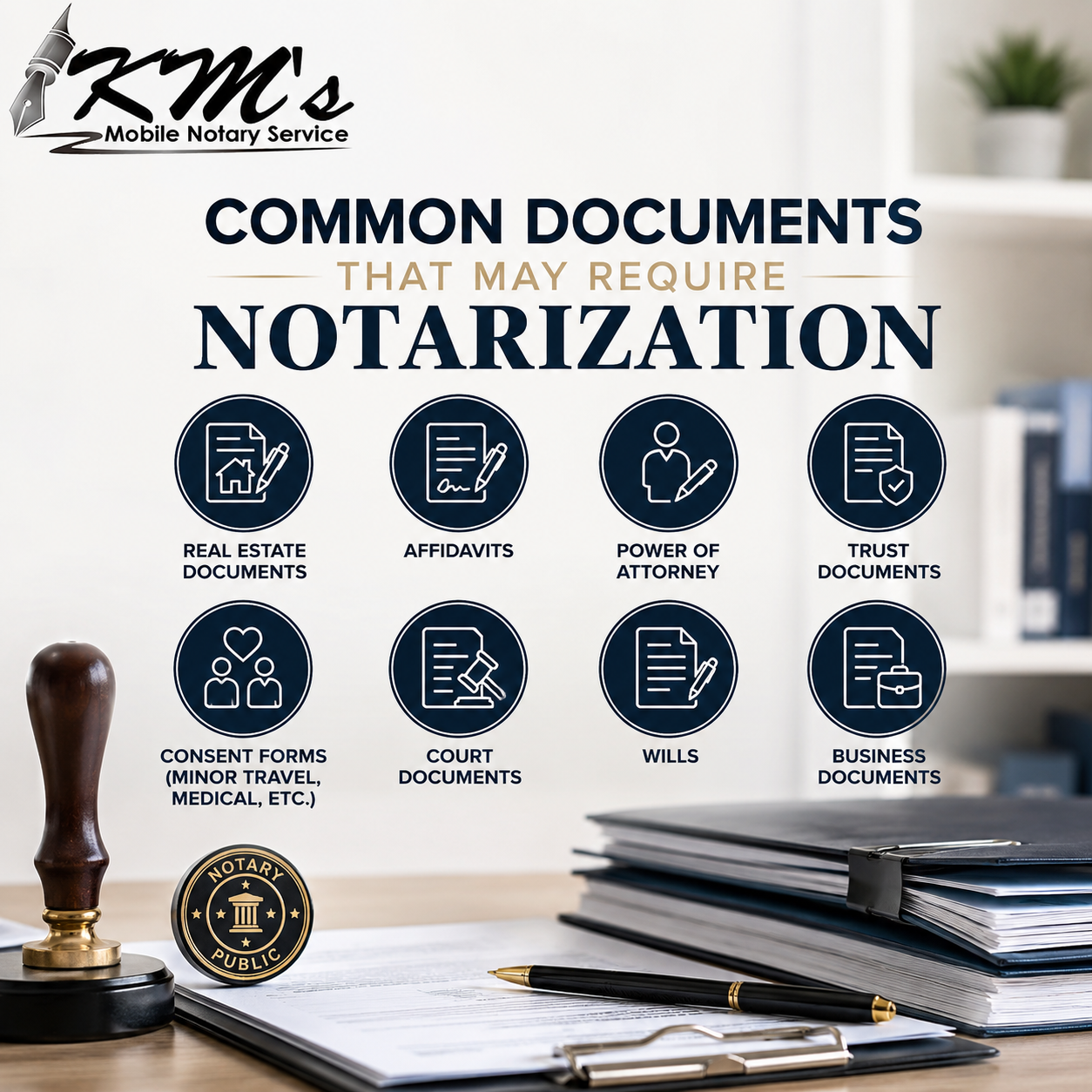
The exact notarization requirement depends on the document, transaction, and instructions from the organization requesting it. However, several categories of documents frequently involve notarization.
A power of attorney allows one person to authorize another person to act on their behalf for specified matters. Depending on the type of power of attorney and the circumstances, notarization may be required or strongly recommended.
These documents can involve financial matters, property transactions, business responsibilities, or other personal affairs. Because they can give another individual significant authority, proper identification and execution are especially important.
Before scheduling an appointment, signers should determine whether the document has specific signing or witnessing instructions.
Real estate transactions often involve documents that require notarization. Examples can include certain deeds, affidavits, loan documents, and other property-related paperwork.
Real estate paperwork can be time-sensitive, particularly when it is connected with a purchase, refinance, transfer, or other transaction. Having documents prepared before the appointment can help reduce delays.
If a lender, title company, escrow company, or another institution has provided specific notarization instructions, those instructions should be followed carefully.
Affidavits are written statements in which an individual declares that certain information is true. Some affidavits must be signed before a notary because the signer is making a sworn statement or acknowledgment.
Examples may include affidavits used for administrative, financial, property, court-related, or personal matters.
The notary’s role is to perform the authorized notarial act; the signer remains responsible for the truthfulness and completeness of the statement.
Certain estate-planning documents may involve notarization. Depending on the document and legal requirements, this can include trust-related paperwork, property transfer documents, affidavits, and other estate documents.
Because estate documents can have significant legal consequences, it is important to follow the instructions provided by the attorney or estate-planning professional who prepared the paperwork.
A notary cannot explain which estate-planning option is appropriate or advise a signer about the legal effect of a document.
Businesses may use notarized documents for a variety of purposes. Depending on the transaction, these may include contracts, declarations, affidavits, authorizations, corporate documents, and property-related paperwork.
Business owners and representatives should review the signing requirements in advance, especially when multiple people need to sign or when documents are being submitted to a government agency, financial institution, or another organization.
Some legal documents may require notarization before they can be submitted or accepted. Affidavits, declarations, sworn statements, and certain authorizations are examples.
Not every court document needs notarization, so signers should carefully review the instructions associated with the paperwork.
If a court, attorney, or government agency has specifically instructed you to have a document notarized, bring those instructions to the appointment when appropriate.
Certain authorization forms and consent documents may require notarization. These documents can be used in personal, financial, educational, medical, property, or administrative situations.
The organization requesting the document should confirm whether notarization is required and whether there are additional witnessing or identification requirements.
Not every document need notarization. Some agreements, forms, applications, and ordinary business documents can be signed without a notary unless a specific party or law requires notarization.
This is why it is important not to assume that every signature requires a notary.
If you are uncertain, check the document instructions or contact the organization requesting the paperwork. If the document was prepared by an attorney, title company, lender, escrow company, or government agency, follow their requirements.
Preparation can help make the appointment straightforward. Before meeting with a notary, consider the following:
If witnesses are required, confirm in advance who is responsible for providing them. Notarial witnessing requirements can differ from ordinary document-signing arrangements.
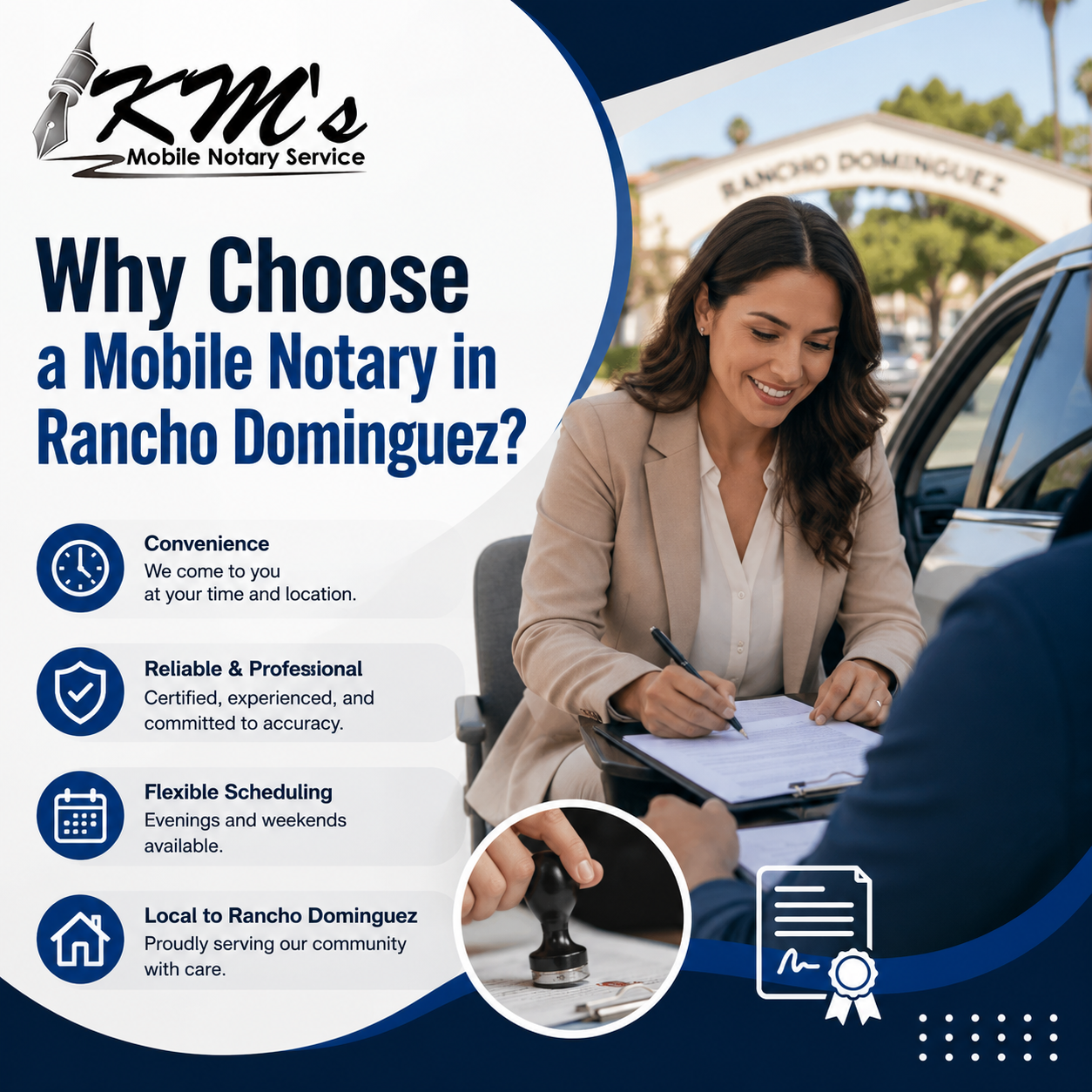
One of the main advantages of mobile notarization is convenience. Instead of traveling to a traditional office, clients can arrange for a notary to meet them at a mutually convenient location, subject to availability and applicable service terms.
This can be useful for people managing busy schedules, businesses coordinating multiple documents, families handling important paperwork, and clients who prefer an appointment at a convenient location.
KM’s Mobile Notary Service provides reliable mobile notary assistance for important document signing, giving clients a practical way to arrange notarization.
Mobile service can also reduce unnecessary travel when documents need to be signed within a particular timeframe. Clients should still prepare their paperwork and identification before the appointment so the notarial process can proceed efficiently.
A few simple preparation steps can prevent common appointment problems.
First, review the document before the appointment. Make sure the required sections are complete, while leaving any portions that must be completed during notarization blank.
Second, confirm the identity requirements. The notary must follow applicable California rules regarding identification and the notarial act being performed.
Third, verify that everyone who needs to sign will be available. A notary generally cannot notarize the signature of someone who is not personally present for the required notarial act.
Finally, confirm the location, appointment time, number of documents, and number of signers before the appointment.
Clients sometimes have multiple documents requiring notarization at the same appointment. This can include real estate paperwork, business documents, affidavits, powers of attorney, or estate-related documents.
When several documents are involved, it helps to organize them in advance. Keep each document together and identify which pages contain notarial certificates. This makes it easier to determine what needs to be signed and notarized.
If you are working with an attorney, lender, escrow company, or another professional, ask whether all documents should be completed during the same appointment.
Mobile notarization can be especially useful when convenience and scheduling flexibility are important. Instead of making a separate trip to a notary office, clients may be able to arrange an appointment at a suitable location.
This can be helpful for:
A mobile notary can help simplify the logistics of getting documents signed and notarized, while the signer remains responsible for understanding the document and meeting any requirements established by the requesting organization.
What documents commonly require notarization?
Common examples can include certain powers of attorney, deeds, affidavits, sworn statements, trust-related documents, business documents, authorization forms, and other paperwork when notarization is required by law or the receiving organization.
Does every legal document need to be notarized?
No. Not every legal or business document requires notarization. The requirement depends on the type of document, applicable law, and instructions from the organization receiving the document.
Can a notary tell me whether my document is legally correct?
No. A notary’s role is limited to performing authorized notarial duties. A notary generally cannot provide legal advice or determine whether a document is legally appropriate for your situation.
Do I need identification for notarization?
Acceptable identification may be required depending on the notarial act and applicable California requirements. It is best to confirm identification requirements before the appointment.
Can I sign the document before meeting the notary?
Do not assume that you can. Some notarizations require the signer to sign in the notary’s presence. Follow the instructions provided with your document and ask the notary if you are unsure.
Can multiple documents be notarized during one appointment?
Potentially, yes. The number and type of documents, number of signers, and applicable notarial requirements can affect the appointment. Let the notary know in advance if you have multiple documents.
Can a mobile notary come to my location in Rancho Dominguez?
Mobile notary appointments may be available at convenient client locations, depending on scheduling, service area, and other applicable conditions. Contact the service provider in advance to confirm availability.
What should I do if I am unsure whether my document needs notarization?
Check the document instructions or contact the organization that requested the paperwork. If an attorney prepared the document, you can also ask the attorney about the signing requirements.
When important paperwork needs notarization, proper preparation can make the signing process more convenient. Whether you are handling a power of attorney, affidavit, real estate document, business form, authorization, or another qualifying document, understanding the notarization requirements beforehand can help prevent unnecessary delays.
For local assistance, convenient mobile notary services in Rancho Dominguez can be a practical option for clients who prefer mobile service.
If you are ready to discuss your notarization needs, schedule a convenient mobile notary appointment and provide details about your documents, number of signers, preferred location, and requested appointment time.
Get reliable mobile notary assistance for important document signing through KM’s Mobile Notary Service. Contact the team to discuss your documents, confirm service availability, and arrange a convenient appointment.
Need documents notarized without making an unnecessary trip? Schedule a convenient mobile notary appointment with KM’s Mobile Notary Service and discuss your Rancho Dominguez notarization needs today.
Copyright © Keith McGruder. All rights reserved. | Website Design & SEO by